



Blog & Ecommerce tips

B2B E-commerce Platform for Growing Businesses
When a reseller calls to place an order using their agreed pricing, with delivery to multiple addresses and project-specific references, a standard online store is not enough. A B2B e-commerce platform needs to handle the business rules behind the purchase – without sales, warehouse and finance teams having to manage exceptions through emails, spreadsheets and phone calls.
This is where many B2B initiatives either start saving time or create more administration than they replace. The difference is rarely how attractive the product page looks. It is how well the platform supports your actual workflows: customer-specific terms, product information, orders, packing, purchasing, invoicing data and follow-up.
B2B commerce is more than a store with a login
In B2C, the buying journey is often relatively straightforward: the customer sees a price, pays and receives their delivery. B2B purchasing has more layers. A customer may have multiple users, multiple delivery addresses and different permission levels. Product ranges may differ between customer groups, prices may be negotiated and orders may need to be reviewed before they are processed.
This means that a platform for B2B sales needs to function as part of the business rather than as a standalone storefront. It should give customers the freedom to place orders themselves while ensuring that the rules previously held in salespeople's heads or spread across several different systems are applied correctly.
For a wholesaler, this might mean displaying different product ranges for construction companies, resellers and public-sector organisations. For a brand, it could mean allowing resellers to order in carton quantities, view campaign terms and access product materials. For a manufacturer, the priority may be enabling customers to reorder frequently purchased items quickly and receive accurate delivery information.
What a B2B e-commerce platform needs to handle
There is no single requirements list that applies to every business, but some areas almost always affect both the customer experience and internal efficiency.
Customer-specific pricing and terms
A public list price is rarely the whole story in B2B. Customers may have negotiated discounts, project pricing, different VAT rules, minimum order values or specific payment terms. The platform needs to be able to apply these automatically when the appropriate customer logs in.
This reduces the risk of incorrect pricing and allows customers to order when it suits them, without waiting for a quotation or manual order entry. At the same time, you need to decide how much should be automated. Complex or unusual transactions may still require approval, but recurring business should not place an unnecessary administrative burden on your team.
Product data that helps customers buy
B2B customers often make purchasing decisions based on specifications, compatibility, packaging quantities, stock availability and documentation. Incomplete product data slows down the purchasing process and increases the number of questions directed to customer service.
PIM functionality makes it easier to manage technical data, images, documents, variants and sales content in one place. When the same information is used across the online store, order workflows and reseller materials, it becomes easier to keep the product range accurate and up to date. This is particularly valuable as the product range grows or when several people are responsible for managing content.
Order workflows that reflect how your business works
An order may need to be split across several deliveries, sent to an alternative address or include a purchase order or project reference. Some customers should be able to place orders directly, while others may require approval from a purchasing manager. The platform needs to accommodate these differences without making standard purchases unnecessarily complicated.
It is worth identifying which exceptions actually occur regularly. There is little value in building an advanced workflow for something that happens twice a year. But if warehouse staff are correcting addresses, changing items or chasing order references every day, that is a clear sign that the system needs to better support the way the business operates.
Stock, purchasing and delivery information
A B2B order is not complete when the customer clicks the buy button. That is when the operational work begins. Stock information needs to be reliable, picking lists must reach the right people and backorders need to be managed without leaving the customer uninformed.
When stock management, packing and picking, purchasing and order handling work together, the team is better equipped to prioritise. You can see what can be shipped immediately, what needs to be purchased and which orders require attention. Customers, in turn, receive clearer information, helping to maintain confidence even when an order cannot be dispatched the same day.
Start with your processes, not the theme
A common mistake is choosing a platform based on a demo store. Design matters, but it rarely determines whether the solution will work well six months later. Instead, start with the activities that currently require the most manual work.
Ask sales, customer service, warehouse and finance teams to describe a typical day of processing orders. When does an order arrive? What information is frequently missing? What needs to be changed manually? What data needs to reach the accounting system? And where do misunderstandings occur between systems?
Once these processes have been mapped, the requirements become clearer. You may need customer-specific product ranges, purchasing suggestions based on orders, automated accounting data or an integration with an external ERP system. This provides a much better basis for choosing a solution than a long list of features that sound impressive but do not solve a specific problem.
When standard functionality is enough – and when customisation is needed
Standard functionality is a strength when it addresses a recurring requirement clearly and effectively. It allows for faster implementation, easier maintenance and less dependence on custom solutions. For a business with only a few customer groups, straightforward pricing and a limited product range, a more standardised solution may be entirely sufficient.
However, when the business depends on its own order rules, industry-specific product data or specialised warehouse workflows, a rigid platform can become expensive in practice. Work is then moved outside the system, with staff compensating through manual checks, additional administration and temporary procedures that eventually become permanent.
The right question is therefore not whether you want customisation. The question is which adaptations create measurable value and which simply preserve outdated ways of working. An experienced technology partner should be able to challenge requirements, suggest simpler processes and extend the platform where the business genuinely requires it.
Avoid creating a patchwork of suppliers
Many e-commerce businesses start with an online store, add a PIM, connect separate payment services, hire an agency for design and bring in additional specialists for integrations. Each component may work well on its own. The problem arises when something stops working and nobody has overall responsibility.
An integrated solution simplifies both operations and development. When product data, checkout, order management, stock, purchasing, reporting and accounting data can be managed in or through the same platform, there are fewer handovers and responsibilities become clearer. It also makes it easier to understand the consequences of a change before it affects customers or internal teams.
Hosting, security, updates and support are not secondary considerations. They determine how reliably the system operates under heavy demand, when an important customer cannot access their account or when a new integration needs to be launched. For growing businesses, fast support from people who understand both the platform and the realities of commerce is often more valuable than a long list of add-ons.
Talex brings e-commerce, product information, order management, stock, purchasing, reporting and integrations together in a unified platform.
When standard functionality is not enough, we can also develop custom functionality and workflows based on the way your business operates. This means fewer systems and suppliers to coordinate, clearer technical responsibility and a platform that can evolve as your business grows.
Measure whether the platform is making work easier
A B2B e-commerce initiative should be evaluated based on its impact on day-to-day operations, not only on the sales curve. Increased order volumes are positive, but you should also look at how many orders require manual correction, how quickly new customers can start purchasing and how many customer service enquiries relate to pricing, order status or delivery.
It is also worth monitoring repeat purchases, average order value, the proportion of orders placed through self-service and the time from order to picking. If customers are placing more orders themselves while your team spends less time on routine administration, the platform is beginning to do its share of the work.
The best starting point is rarely to digitalise everything at once. Choose the workflow that currently consumes the most time or causes the most errors and build from there. When technology takes responsibility for repetitive tasks, your people have more time to focus on product ranges, customer relationships and the business opportunities that actually drive growth.
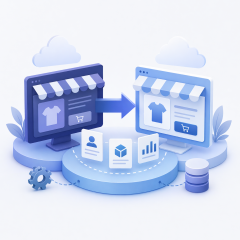
Switching e-commerce platform – what should you consider?
Switching e-commerce platform is a major step, often driven by the fact that your current solution no longer meets your needs. It may be due to limitations in functionality, difficulties scaling, or that the system no longer supports how your business operates.
But a successful platform switch isn’t just about solving today’s problems — it’s about creating the right conditions for future growth.
🔍 Start with your needs
The foundation of a good decision is understanding why you want to switch.
What challenges are you facing today? And what will you need going forward?
Only when these questions are clear can you choose the right solution.
⚙️ Look beyond standard features
Many platforms offer similar core functionality. The real difference lies in how well the system can be adapted to your specific business.
Every e-commerce business has unique needs:
- different business logic
- specific workflows
- integrations with existing systems
That’s why it’s crucial that the platform doesn’t define your limits — but can be shaped around your business.
🚀 Continuous development is key
An e-commerce platform is never “finished”. It needs to evolve continuously as your business grows and changes.
This may include:
- new features
- updated customer experiences
- integrations with new systems
- improvements to internal processes
If the platform is limited in how it can be extended, it quickly becomes a bottleneck instead of a support.
A flexible solution — where both functionality and integrations can be developed based on your specific needs — creates far better conditions for long-term growth.
🔗 Integrations and ecosystem
Most businesses rely on multiple systems — for example for logistics, payments, ERP, and marketing.
That’s why it’s important that the platform:
- can easily integrate with other systems
- doesn’t lock you into a restricted ecosystem
The ability to connect the right tools for your specific business is often critical for efficiency and scalability.
🧠 Think holistically
Beyond technology, you also need to consider:
- data and SEO migration
- day-to-day usability
- performance and scalability
All parts need to work together for the transition to be successful.
📈 Summary
Switching e-commerce platform is ultimately about choosing a solution that can adapt to your business — not the other way around.
The most important factors are:
- clear business needs
- flexibility in functionality and integrations
- the ability to continuously develop
A platform that can be shaped around your business and evolve over time provides the best foundation for long-term growth.

Inspiration without limits for your webshop
✨ Inspiration without limits for your webshop
What could your next webshop look like – visually, technically, and strategically?
We’ve gathered design expressions and functional layouts that showcase the full range of what’s possible in modern e-commerce.
These are not finished customer cases, but inspirational concepts that demonstrate how we can tailor everything from conversion-driven design to technically advanced solutions – entirely based on your needs.
Whether you’re aiming for something clean, creative, or highly scalable, we take the idea all the way from concept to a finished webshop.
👉 Explore the inspiration here: https://talex.se/mallar
💬 Want to see how your webshop could be built? Get in touch.

Summer is here – but that doesn’t mean your online store has to stand still.
🏖️ Summer is here – but that doesn’t mean your online store has to stand still.
🕹️ Spark buying interest and boost repeat traffic with auctions in your webshop!
Want more visitors to come back – and increase your sales at the same time? With our easy-to-use Auction Module, you can list products for bidding directly in your store.
Customers get involved, follow the bidding, and return to participate – often leading to more purchases, even of other products.
✔ Creates activity and engagement
✔ Brings visitors back
✔ Often leads to increased sales
✔ Easy to get started
👉 Learn more and order at https://talex.se/auction-module
Got questions? Just reach out to us!
💡 Tip: Summer campaign + auction = more sales
Combine time-limited offers with auctions – for example, “Last Minute” bidding on selected products each week. It creates movement in your store and keeps visitors engaged!
We at Talex wish you a wonderful summer! ☀️
Our support is open as usual during the summer, though response times may be slightly longer some weeks.
Take the opportunity to recharge, enjoy the sun, warmth, and some well-deserved time off!

Klarna Checkout becomes Kustom – what does it mean for you as a Talex customer?
🛍️ Klarna Checkout (KCO) has not only changed its name to Kustom Checkout – it has also become an independent company after being sold to an investor group led by Kamjar Hajabdolahi, CEO of BLQ Invest.
This transition means that KCO is now a standalone entity focused on developing a tailored checkout solution for e-commerce merchants, while Klarna remains a key payment option within the Kustom offering.
For Talex customers, the migration is completely seamless 🚀 – there is no action required on your part.
🆕 What is Kustom?
Kustom is the next evolution of Klarna Checkout, now operating as an independent company.
With over 24,000 connected merchants and more than SEK 150 billion in annual transaction volume, Kustom is one of Europe’s leading digital checkout solutions.
Several key people from Klarna Checkout – including Jesper Eriksson (former Klarna Sweden Country Manager) and Rasmus Fahlander (former Head of Product for Klarna Checkout) – have joined Kustom, ensuring continuity and deep expertise in the product’s future development.
🤝 What does this mean for Talex customers?
As a Talex customer, you don’t need to do anything – the transition to Kustom happens automatically.
Kustom Checkout continues to be included in all our packages, with no monthly or setup fees.
You keep all existing features and gain access to upcoming improvements.
💳 Benefits of Kustom Checkout
🌍 More payment options:
Thanks to a strategic partnership with Stripe, Kustom will offer over 100 payment methods, including both local and international options.
📈 Higher conversion:
Kustom’s pre-filled, mobile-optimized checkout flow makes it easier for customers to complete their purchases.
🎨 Customizable design:
Tailor the checkout experience to match your store’s brand, language, currency, and shipping options.
☎️ Improved support:
Kustom is investing in stronger customer support to provide faster assistance to merchants.
🗓️ What’s next?
In 2025, Kustom will launch even more features and payment alternatives, aiming to become Europe’s most flexible and powerful checkout solution.
Klarna will remain a key payment method, so your customers can still choose to pay with Klarna.

Google’s Latest Algorithm Update
Important Information About Google’s Latest Algorithm Update
Google has launched its first major search algorithm update of the year, the "March 2025 Core Update." The update is being rolled out gradually over approximately two weeks and aims to highlight more relevant content in the search results. This may affect visibility for e-commerce businesses and other website owners.
What should you do?
🔹 Stay calm – Google often makes adjustments during the rollout.
🔹 Monitor your visibility – Track how your product pages and categories perform in the search results.
🔹 Analyze before acting – Changes may be temporary, so avoid making hasty decisions.
For more information and expert advice, read the full article here:
👉 Ehandel.se – This Year’s First Major Update: Expert – Don’t Act Hastily
B2B E-Commerce: Key Features You Need
B2B e-commerce is evolving rapidly, and companies that want to stay ahead must adapt to new technologies and customer expectations. 2025 is the year when automation, personalization, and seamless integration become crucial success factors. In this article, we go through the key features you need to create a competitive B2B webshop.
1. Advanced Customer Customization
B2B customers often have specific needs, and a standardized solution is not enough. Key customization features include:
-
Individual price lists – Offer unique prices based on customer category.
-
Customized product catalogs – Display relevant products for each customer.
-
Volume-based discounts – Automate price adjustments based on order volume.
A platform that supports these features provides a more personalized shopping experience and strengthens customer relationships.
2. Self-Service and Automated Processes
B2B customers want the ability to manage their orders without contacting a salesperson. Key self-service features include:
-
Reorder functions – Allow customers to quickly reorder previous purchases.
-
Order status and tracking – Transparent real-time updates.
-
Invoice management and payment options – Give customers the flexibility to choose payment methods, including invoicing, installment payments, and credit card payments.
Automating these processes saves time for both the customer and the company.
3. Seamless Integration with Business Systems (ERP & CRM)
Efficient B2B platforms must integrate with the company’s existing systems. Key integrations include:
-
ERP systems (Enterprise Resource Planning) – Connect to business systems like Fortnox, SAP, or Microsoft Dynamics to synchronize inventory, invoicing, and customer data.
-
CRM systems (Customer Relationship Management) – Improve customer management and sales insights through integrations with platforms like HubSpot or Salesforce.
-
PIM systems (Product Information Management) – Centralized management of product information across multiple channels.
By integrating these systems, you can automate workflows and minimize manual work.
4. Mobile-Optimized B2B Commerce
More decision-makers handle their purchases directly from mobile devices. A modern B2B webshop must be optimized for mobile devices and include:
-
Responsive design – Seamless user experience regardless of screen size.
-
Fast loading times – Optimization for speed and performance.
-
Mobile-friendly payment solutions – Support for Swish and other seamless options.
Ignoring mobile optimization can lead to customers choosing another supplier.
5. AI-Driven Personalization
Artificial intelligence is revolutionizing B2B e-commerce by offering:
-
Dynamic product recommendations based on purchasing behaviors.
-
Automated quote proposals tailored to the customer’s previous purchases.
-
AI-driven chatbot for fast customer service and support.
AI can enhance the customer experience and increase conversions by delivering relevant content at the right time.
6. Sustainability and Transparency
Sustainability is becoming an increasingly important factor in B2B e-commerce. Companies that prioritize environmentally friendly options strengthen their brand. Key features include:
-
Supply chain traceability – Clear information about product origins.
-
CO2 calculations for deliveries – Show customers how their purchases impact the environment.
-
Sustainable shipping options – Offer green delivery choices like fossil-free transport.
By integrating sustainability initiatives, you can attract more conscious business customers.
7. Security and Data Protection
B2B commerce often involves sensitive business data. A secure platform should have:
-
Two-factor authentication (2FA) for increased security during login.
-
SSL encryption to protect transactions.
-
Regular security updates and backup solutions.
Prioritizing cybersecurity builds trust and protects both the company and its customers.
Conclusion
B2B e-commerce is evolving rapidly, and companies that want to succeed in 2024 must invest in modern features like automation, AI-driven personalization, and seamless integrations. By implementing these key functions, you can create a future-proof platform that drives sales and strengthens customer relationships.
Are you ready to take your B2B webshop to the next level? Contact Talex for a customized e-commerce solution!

E-commerce Trends in 2025
AI as a Key Trend
AI is a central trend highlighted by all experts. The technology is expected to revolutionize e-commerce through improvements in:
- Customer Service: More companies will adopt AI-driven solutions, although the technology is not yet fully mature.
- Product Enrichment: Generative AI can simplify content production and process automation.
- Personalization: AI helps tailor the customer experience through personalized recommendations, dynamic pricing, and optimized search functionality.
- Internal Processes: AI is anticipated to boost productivity in areas like inventory management, analytics, and operational flow optimization.
Despite these significant benefits, concerns remain about companies rushing implementation before the technology is sufficiently developed.
New EU Regulations
EU regulations will impact e-commerce in several ways in 2025:
- Accessibility Directive (WCAG 2): Requirements to make digital platforms more accessible for people with disabilities will come into effect, necessitating both technical development and changes in workflows.
- General Product Safety Regulation (GPSR): Higher demands for product information, such as recycling data and manufacturing addresses, will be introduced.
- CSRD (Corporate Sustainability Reporting Directive): Companies will need to report on product origin, resource consumption, and carbon footprint.
Global actors that do not comply with European regulations pose a challenge, creating an uneven playing field for Swedish e-commerce companies.
Product Enrichment and Personalization
Increasing customer demands for tailored shopping experiences are driving innovations in:
- Product Enrichment: AI is being used to automate and enhance product descriptions and content.
- Personalization: E-commerce platforms are leveraging AI to optimize customer journeys, from personalized recommendations to search experiences adapted for new platforms like ChatGPT.
- Speed and Accessibility: Rising consumer expectations for faster load times and deliveries are putting pressure on e-commerce businesses to perform better than ever.
Personalized live shopping via social media is also expected to grow, with creators and brands interacting directly with customers in real-time.
This text is a summary of the following article: E-commerce Experts on 2025: "All the Dinosaurs Will Get a Hard Wake-Up Call"
At Talex, we help our clients stay ahead of the curve. By offering innovative and customizable solutions, we can support you in adapting to emerging trends and regulations. Here are some of our modules that can strengthen your online store:
- Advanced Product Boxes, customized based on your customers’ behavior in the store, complete with detailed insights via admin panel reports.
- Product Associations, such as “Customers who bought this product also bought…”
- Accessibility Basic & Accessibility Plus, for making your webshop more accessible.
- Customer Chat / Live Chat Integration, enabling direct communication between you and your customers.
- Advanced Internal Search Engine, offering fast search results with relevant suggestions, spell-check, and search statistics for an improved user experience.
- Service Card, where we can develop tailored features based on your specific ideas.

Product Images
✨ Enhance your e-commerce with fantastic product images! ✨
To stand out and increase your chances of selling, it's crucial that your product images are of high quality. Here's why it's so important:
- First Impressions Matter: Customers form their first impression of your product through images, so ensure they are professional and appealing.
- Build Trust: Clear and detailed images show that you have nothing to hide and build trust.
- Reduce Returns: When customers know exactly what to expect, the risk of dissatisfaction and returns decreases.
💡 Tips for Better Images:
- Use natural light whenever possible.
- Show the product in use to provide a better understanding.
- Edit the images to highlight the best details, but avoid excessive filters.
Invest in your product images and see how it makes a difference for your e-commerce! 📸🚀
When a reseller calls to place an order using their agreed pricing, with delivery to multiple addresses and project-specific references, a standard online store is not enough. A B2B e-commerce platform needs to handle the business rules behind the purchase – without sales, warehouse and finance teams having to manage exceptions through emails, spreadsheets and phone calls.
This is where many B2B initiatives either start saving time or create more administration than they replace. The difference is rarely how attractive the product page looks. It is how well the platform supports your actual workflows: customer-specific terms, product information, orders, packing, purchasing, invoicing data and follow-up.
B2B commerce is more than a store with a login
In B2C, the buying journey is often relatively straightforward: the customer sees a price, pays and receives their delivery. B2B purchasing has more layers. A customer may have multiple users, multiple delivery addresses and different permission levels. Product ranges may differ between customer groups, prices may be negotiated and orders may need to be reviewed before they are processed.
This means that a platform for B2B sales needs to function as part of the business rather than as a standalone storefront. It should give customers the freedom to place orders themselves while ensuring that the rules previously held in salespeople's heads or spread across several different systems are applied correctly.
For a wholesaler, this might mean displaying different product ranges for construction companies, resellers and public-sector organisations. For a brand, it could mean allowing resellers to order in carton quantities, view campaign terms and access product materials. For a manufacturer, the priority may be enabling customers to reorder frequently purchased items quickly and receive accurate delivery information.
What a B2B e-commerce platform needs to handle
There is no single requirements list that applies to every business, but some areas almost always affect both the customer experience and internal efficiency.
Customer-specific pricing and terms
A public list price is rarely the whole story in B2B. Customers may have negotiated discounts, project pricing, different VAT rules, minimum order values or specific payment terms. The platform needs to be able to apply these automatically when the appropriate customer logs in.
This reduces the risk of incorrect pricing and allows customers to order when it suits them, without waiting for a quotation or manual order entry. At the same time, you need to decide how much should be automated. Complex or unusual transactions may still require approval, but recurring business should not place an unnecessary administrative burden on your team.
Product data that helps customers buy
B2B customers often make purchasing decisions based on specifications, compatibility, packaging quantities, stock availability and documentation. Incomplete product data slows down the purchasing process and increases the number of questions directed to customer service.
PIM functionality makes it easier to manage technical data, images, documents, variants and sales content in one place. When the same information is used across the online store, order workflows and reseller materials, it becomes easier to keep the product range accurate and up to date. This is particularly valuable as the product range grows or when several people are responsible for managing content.
Order workflows that reflect how your business works
An order may need to be split across several deliveries, sent to an alternative address or include a purchase order or project reference. Some customers should be able to place orders directly, while others may require approval from a purchasing manager. The platform needs to accommodate these differences without making standard purchases unnecessarily complicated.
It is worth identifying which exceptions actually occur regularly. There is little value in building an advanced workflow for something that happens twice a year. But if warehouse staff are correcting addresses, changing items or chasing order references every day, that is a clear sign that the system needs to better support the way the business operates.
Stock, purchasing and delivery information
A B2B order is not complete when the customer clicks the buy button. That is when the operational work begins. Stock information needs to be reliable, picking lists must reach the right people and backorders need to be managed without leaving the customer uninformed.
When stock management, packing and picking, purchasing and order handling work together, the team is better equipped to prioritise. You can see what can be shipped immediately, what needs to be purchased and which orders require attention. Customers, in turn, receive clearer information, helping to maintain confidence even when an order cannot be dispatched the same day.
Start with your processes, not the theme
A common mistake is choosing a platform based on a demo store. Design matters, but it rarely determines whether the solution will work well six months later. Instead, start with the activities that currently require the most manual work.
Ask sales, customer service, warehouse and finance teams to describe a typical day of processing orders. When does an order arrive? What information is frequently missing? What needs to be changed manually? What data needs to reach the accounting system? And where do misunderstandings occur between systems?
Once these processes have been mapped, the requirements become clearer. You may need customer-specific product ranges, purchasing suggestions based on orders, automated accounting data or an integration with an external ERP system. This provides a much better basis for choosing a solution than a long list of features that sound impressive but do not solve a specific problem.
When standard functionality is enough – and when customisation is needed
Standard functionality is a strength when it addresses a recurring requirement clearly and effectively. It allows for faster implementation, easier maintenance and less dependence on custom solutions. For a business with only a few customer groups, straightforward pricing and a limited product range, a more standardised solution may be entirely sufficient.
However, when the business depends on its own order rules, industry-specific product data or specialised warehouse workflows, a rigid platform can become expensive in practice. Work is then moved outside the system, with staff compensating through manual checks, additional administration and temporary procedures that eventually become permanent.
The right question is therefore not whether you want customisation. The question is which adaptations create measurable value and which simply preserve outdated ways of working. An experienced technology partner should be able to challenge requirements, suggest simpler processes and extend the platform where the business genuinely requires it.
Avoid creating a patchwork of suppliers
Many e-commerce businesses start with an online store, add a PIM, connect separate payment services, hire an agency for design and bring in additional specialists for integrations. Each component may work well on its own. The problem arises when something stops working and nobody has overall responsibility.
An integrated solution simplifies both operations and development. When product data, checkout, order management, stock, purchasing, reporting and accounting data can be managed in or through the same platform, there are fewer handovers and responsibilities become clearer. It also makes it easier to understand the consequences of a change before it affects customers or internal teams.
Hosting, security, updates and support are not secondary considerations. They determine how reliably the system operates under heavy demand, when an important customer cannot access their account or when a new integration needs to be launched. For growing businesses, fast support from people who understand both the platform and the realities of commerce is often more valuable than a long list of add-ons.
Talex brings e-commerce, product information, order management, stock, purchasing, reporting and integrations together in a unified platform.
When standard functionality is not enough, we can also develop custom functionality and workflows based on the way your business operates. This means fewer systems and suppliers to coordinate, clearer technical responsibility and a platform that can evolve as your business grows.
Measure whether the platform is making work easier
A B2B e-commerce initiative should be evaluated based on its impact on day-to-day operations, not only on the sales curve. Increased order volumes are positive, but you should also look at how many orders require manual correction, how quickly new customers can start purchasing and how many customer service enquiries relate to pricing, order status or delivery.
It is also worth monitoring repeat purchases, average order value, the proportion of orders placed through self-service and the time from order to picking. If customers are placing more orders themselves while your team spends less time on routine administration, the platform is beginning to do its share of the work.
The best starting point is rarely to digitalise everything at once. Choose the workflow that currently consumes the most time or causes the most errors and build from there. When technology takes responsibility for repetitive tasks, your people have more time to focus on product ranges, customer relationships and the business opportunities that actually drive growth.
Switching e-commerce platform is a major step, often driven by the fact that your current solution no longer meets your needs. It may be due to limitations in functionality, difficulties scaling, or that the system no longer supports how your business operates.
But a successful platform switch isn’t just about solving today’s problems — it’s about creating the right conditions for future growth.
🔍 Start with your needs
The foundation of a good decision is understanding why you want to switch.
What challenges are you facing today? And what will you need going forward?
Only when these questions are clear can you choose the right solution.
⚙️ Look beyond standard features
Many platforms offer similar core functionality. The real difference lies in how well the system can be adapted to your specific business.
Every e-commerce business has unique needs:
- different business logic
- specific workflows
- integrations with existing systems
That’s why it’s crucial that the platform doesn’t define your limits — but can be shaped around your business.
🚀 Continuous development is key
An e-commerce platform is never “finished”. It needs to evolve continuously as your business grows and changes.
This may include:
- new features
- updated customer experiences
- integrations with new systems
- improvements to internal processes
If the platform is limited in how it can be extended, it quickly becomes a bottleneck instead of a support.
A flexible solution — where both functionality and integrations can be developed based on your specific needs — creates far better conditions for long-term growth.
🔗 Integrations and ecosystem
Most businesses rely on multiple systems — for example for logistics, payments, ERP, and marketing.
That’s why it’s important that the platform:
- can easily integrate with other systems
- doesn’t lock you into a restricted ecosystem
The ability to connect the right tools for your specific business is often critical for efficiency and scalability.
🧠 Think holistically
Beyond technology, you also need to consider:
- data and SEO migration
- day-to-day usability
- performance and scalability
All parts need to work together for the transition to be successful.
📈 Summary
Switching e-commerce platform is ultimately about choosing a solution that can adapt to your business — not the other way around.
The most important factors are:
- clear business needs
- flexibility in functionality and integrations
- the ability to continuously develop
A platform that can be shaped around your business and evolve over time provides the best foundation for long-term growth.
✨ Inspiration without limits for your webshop
What could your next webshop look like – visually, technically, and strategically?
We’ve gathered design expressions and functional layouts that showcase the full range of what’s possible in modern e-commerce.
These are not finished customer cases, but inspirational concepts that demonstrate how we can tailor everything from conversion-driven design to technically advanced solutions – entirely based on your needs.
Whether you’re aiming for something clean, creative, or highly scalable, we take the idea all the way from concept to a finished webshop.
👉 Explore the inspiration here: https://talex.se/mallar
💬 Want to see how your webshop could be built? Get in touch.
🏖️ Summer is here – but that doesn’t mean your online store has to stand still.
🕹️ Spark buying interest and boost repeat traffic with auctions in your webshop!
Want more visitors to come back – and increase your sales at the same time? With our easy-to-use Auction Module, you can list products for bidding directly in your store.
Customers get involved, follow the bidding, and return to participate – often leading to more purchases, even of other products.
✔ Creates activity and engagement
✔ Brings visitors back
✔ Often leads to increased sales
✔ Easy to get started
👉 Learn more and order at https://talex.se/auction-module
Got questions? Just reach out to us!
💡 Tip: Summer campaign + auction = more sales
Combine time-limited offers with auctions – for example, “Last Minute” bidding on selected products each week. It creates movement in your store and keeps visitors engaged!
We at Talex wish you a wonderful summer! ☀️
Our support is open as usual during the summer, though response times may be slightly longer some weeks.
Take the opportunity to recharge, enjoy the sun, warmth, and some well-deserved time off!
🛍️ Klarna Checkout (KCO) has not only changed its name to Kustom Checkout – it has also become an independent company after being sold to an investor group led by Kamjar Hajabdolahi, CEO of BLQ Invest.
This transition means that KCO is now a standalone entity focused on developing a tailored checkout solution for e-commerce merchants, while Klarna remains a key payment option within the Kustom offering.
For Talex customers, the migration is completely seamless 🚀 – there is no action required on your part.
🆕 What is Kustom?
Kustom is the next evolution of Klarna Checkout, now operating as an independent company.
With over 24,000 connected merchants and more than SEK 150 billion in annual transaction volume, Kustom is one of Europe’s leading digital checkout solutions.
Several key people from Klarna Checkout – including Jesper Eriksson (former Klarna Sweden Country Manager) and Rasmus Fahlander (former Head of Product for Klarna Checkout) – have joined Kustom, ensuring continuity and deep expertise in the product’s future development.
🤝 What does this mean for Talex customers?
As a Talex customer, you don’t need to do anything – the transition to Kustom happens automatically.
Kustom Checkout continues to be included in all our packages, with no monthly or setup fees.
You keep all existing features and gain access to upcoming improvements.
💳 Benefits of Kustom Checkout
🌍 More payment options:
Thanks to a strategic partnership with Stripe, Kustom will offer over 100 payment methods, including both local and international options.
📈 Higher conversion:
Kustom’s pre-filled, mobile-optimized checkout flow makes it easier for customers to complete their purchases.
🎨 Customizable design:
Tailor the checkout experience to match your store’s brand, language, currency, and shipping options.
☎️ Improved support:
Kustom is investing in stronger customer support to provide faster assistance to merchants.
🗓️ What’s next?
In 2025, Kustom will launch even more features and payment alternatives, aiming to become Europe’s most flexible and powerful checkout solution.
Klarna will remain a key payment method, so your customers can still choose to pay with Klarna.
Important Information About Google’s Latest Algorithm Update
Google has launched its first major search algorithm update of the year, the "March 2025 Core Update." The update is being rolled out gradually over approximately two weeks and aims to highlight more relevant content in the search results. This may affect visibility for e-commerce businesses and other website owners.
What should you do?
🔹 Stay calm – Google often makes adjustments during the rollout.
🔹 Monitor your visibility – Track how your product pages and categories perform in the search results.
🔹 Analyze before acting – Changes may be temporary, so avoid making hasty decisions.
For more information and expert advice, read the full article here:
👉 Ehandel.se – This Year’s First Major Update: Expert – Don’t Act Hastily
B2B e-commerce is evolving rapidly, and companies that want to stay ahead must adapt to new technologies and customer expectations. 2025 is the year when automation, personalization, and seamless integration become crucial success factors. In this article, we go through the key features you need to create a competitive B2B webshop.
1. Advanced Customer Customization
B2B customers often have specific needs, and a standardized solution is not enough. Key customization features include:
-
Individual price lists – Offer unique prices based on customer category.
-
Customized product catalogs – Display relevant products for each customer.
-
Volume-based discounts – Automate price adjustments based on order volume.
A platform that supports these features provides a more personalized shopping experience and strengthens customer relationships.
2. Self-Service and Automated Processes
B2B customers want the ability to manage their orders without contacting a salesperson. Key self-service features include:
-
Reorder functions – Allow customers to quickly reorder previous purchases.
-
Order status and tracking – Transparent real-time updates.
-
Invoice management and payment options – Give customers the flexibility to choose payment methods, including invoicing, installment payments, and credit card payments.
Automating these processes saves time for both the customer and the company.
3. Seamless Integration with Business Systems (ERP & CRM)
Efficient B2B platforms must integrate with the company’s existing systems. Key integrations include:
-
ERP systems (Enterprise Resource Planning) – Connect to business systems like Fortnox, SAP, or Microsoft Dynamics to synchronize inventory, invoicing, and customer data.
-
CRM systems (Customer Relationship Management) – Improve customer management and sales insights through integrations with platforms like HubSpot or Salesforce.
-
PIM systems (Product Information Management) – Centralized management of product information across multiple channels.
By integrating these systems, you can automate workflows and minimize manual work.
4. Mobile-Optimized B2B Commerce
More decision-makers handle their purchases directly from mobile devices. A modern B2B webshop must be optimized for mobile devices and include:
-
Responsive design – Seamless user experience regardless of screen size.
-
Fast loading times – Optimization for speed and performance.
-
Mobile-friendly payment solutions – Support for Swish and other seamless options.
Ignoring mobile optimization can lead to customers choosing another supplier.
5. AI-Driven Personalization
Artificial intelligence is revolutionizing B2B e-commerce by offering:
-
Dynamic product recommendations based on purchasing behaviors.
-
Automated quote proposals tailored to the customer’s previous purchases.
-
AI-driven chatbot for fast customer service and support.
AI can enhance the customer experience and increase conversions by delivering relevant content at the right time.
6. Sustainability and Transparency
Sustainability is becoming an increasingly important factor in B2B e-commerce. Companies that prioritize environmentally friendly options strengthen their brand. Key features include:
-
Supply chain traceability – Clear information about product origins.
-
CO2 calculations for deliveries – Show customers how their purchases impact the environment.
-
Sustainable shipping options – Offer green delivery choices like fossil-free transport.
By integrating sustainability initiatives, you can attract more conscious business customers.
7. Security and Data Protection
B2B commerce often involves sensitive business data. A secure platform should have:
-
Two-factor authentication (2FA) for increased security during login.
-
SSL encryption to protect transactions.
-
Regular security updates and backup solutions.
Prioritizing cybersecurity builds trust and protects both the company and its customers.
Conclusion
B2B e-commerce is evolving rapidly, and companies that want to succeed in 2024 must invest in modern features like automation, AI-driven personalization, and seamless integrations. By implementing these key functions, you can create a future-proof platform that drives sales and strengthens customer relationships.
Are you ready to take your B2B webshop to the next level? Contact Talex for a customized e-commerce solution!
AI as a Key Trend
AI is a central trend highlighted by all experts. The technology is expected to revolutionize e-commerce through improvements in:
- Customer Service: More companies will adopt AI-driven solutions, although the technology is not yet fully mature.
- Product Enrichment: Generative AI can simplify content production and process automation.
- Personalization: AI helps tailor the customer experience through personalized recommendations, dynamic pricing, and optimized search functionality.
- Internal Processes: AI is anticipated to boost productivity in areas like inventory management, analytics, and operational flow optimization.
Despite these significant benefits, concerns remain about companies rushing implementation before the technology is sufficiently developed.
New EU Regulations
EU regulations will impact e-commerce in several ways in 2025:
- Accessibility Directive (WCAG 2): Requirements to make digital platforms more accessible for people with disabilities will come into effect, necessitating both technical development and changes in workflows.
- General Product Safety Regulation (GPSR): Higher demands for product information, such as recycling data and manufacturing addresses, will be introduced.
- CSRD (Corporate Sustainability Reporting Directive): Companies will need to report on product origin, resource consumption, and carbon footprint.
Global actors that do not comply with European regulations pose a challenge, creating an uneven playing field for Swedish e-commerce companies.
Product Enrichment and Personalization
Increasing customer demands for tailored shopping experiences are driving innovations in:
- Product Enrichment: AI is being used to automate and enhance product descriptions and content.
- Personalization: E-commerce platforms are leveraging AI to optimize customer journeys, from personalized recommendations to search experiences adapted for new platforms like ChatGPT.
- Speed and Accessibility: Rising consumer expectations for faster load times and deliveries are putting pressure on e-commerce businesses to perform better than ever.
Personalized live shopping via social media is also expected to grow, with creators and brands interacting directly with customers in real-time.
This text is a summary of the following article: E-commerce Experts on 2025: "All the Dinosaurs Will Get a Hard Wake-Up Call"
At Talex, we help our clients stay ahead of the curve. By offering innovative and customizable solutions, we can support you in adapting to emerging trends and regulations. Here are some of our modules that can strengthen your online store:
- Advanced Product Boxes, customized based on your customers’ behavior in the store, complete with detailed insights via admin panel reports.
- Product Associations, such as “Customers who bought this product also bought…”
- Accessibility Basic & Accessibility Plus, for making your webshop more accessible.
- Customer Chat / Live Chat Integration, enabling direct communication between you and your customers.
- Advanced Internal Search Engine, offering fast search results with relevant suggestions, spell-check, and search statistics for an improved user experience.
- Service Card, where we can develop tailored features based on your specific ideas.
✨ Enhance your e-commerce with fantastic product images! ✨
To stand out and increase your chances of selling, it's crucial that your product images are of high quality. Here's why it's so important:
- First Impressions Matter: Customers form their first impression of your product through images, so ensure they are professional and appealing.
- Build Trust: Clear and detailed images show that you have nothing to hide and build trust.
- Reduce Returns: When customers know exactly what to expect, the risk of dissatisfaction and returns decreases.
💡 Tips for Better Images:
- Use natural light whenever possible.
- Show the product in use to provide a better understanding.
- Edit the images to highlight the best details, but avoid excessive filters.
Invest in your product images and see how it makes a difference for your e-commerce! 📸🚀

